Todd Stern, the US Special Envoy on Climate Change, has just managed the undoable: making the climate negotiations newsworthy in the middle of an Olympic-heavy summer. If only this had been to make constructive proposals rather than question one of the few elements already agreed upon.
Addressing his audience at the Dartmouth College, Stern questioned straightforwardly the relevance of the current objective for global mitigation (the famous “2 degrees” target), calling instead for more flexibility allowing countries to postpone meaningful mitigation action.
 Ironically, “S. E. (Special Envoy) Todd Stern” is actually a very poor anagram for “Todesstern” – the German version of “Death Star”. For anyone unfamiliar with the Star Wars mythology, the Death Star is the ultimate weapon of the evil empire, capable of destroying a whole planet by a single beam of energy. The Stern method will probably requires more than a single shot to achieve anything similar, but by systematically backtracking on any previous agreements and continuously calling for delays, the Star Wars reference threatens to become a good allegory of the US role in these negotiations. (A post on US legacy at the UNFCCC since 1990 is upcoming. I don’t mean to bash the US only – I personally think that the misplaced naivety of some actors is as irresponsible as the stubborn obstructivism of others.)
By contesting the relevance of the two degrees target, the Special Envoy has certainly dealt the biggest blow to progress at the UNFCCC this year. While virtually everyone recognize that the Copenhagen conference was a disastrous failure, the agreement reached in 2009 to stabilize temperatures at a two degrees warming was considered the main/only positive result of the conference. Just last month, Bill McKibben – the co-founder of 350.org – highlighted that the recognition of the two degrees target is actually the one important thing that came out of the 2009 Copenhagen conference (in Rio two months ago, many commented that the best outcome of the Rio+20 conference has also been the agreement to set Sustainable Development Goals, insisting on the importance of having concrete objectives to serve as guideposts and keep all stakeholders focused).
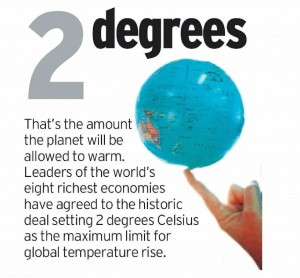 If the 2 degrees target is often questioned at the climate talks, it is only to call for a more stringent target, as two degrees will already have disastrous consequences for those most vulnerable to sea level rise and other climate impacts. A process was even agreed to review the relevance of this particular number and consider establishing a more stringent target by 2015.
The damage done by this backtracking by the US lead negotiator on the two degrees target goes beyond the questioning the relevance of a global target for the climate negotiations. It will also undermine a little more any trust remaining among the climate negotiators that the whole international community is ready to commit during the new round of negotiations towards a climate agreement in 2015 on the basis of previous agreements. Considering how the recent negotiations went in Bonn, trust is definitely not a resource abundant enough at the UNFCCC to be dissipated unilaterally.
In Dartmouth, Stern reiterated once again the vision of the US administration calling for a shift in the climate change negotiations from focusing on short-term action (Stern used to described the cuts suggested by scientists during 2012-2020 as “unnecessary”) and rather holding to the faith that at some point in the future we will have better technologies making emission reduction a piece of cake. But this year marks already the twentieth anniversary of the convention scientists warn us consistently that mitigation action needs to take place as early as possible. You see, Mr. Stern, climate policies is not quite like a basketball game when you can call a time-out and everyone freezes the time for you to sort out matters within your own team. In our physical world, the planet keeps getting warmer, no matter whether you would like more time to figure out a plan or not.
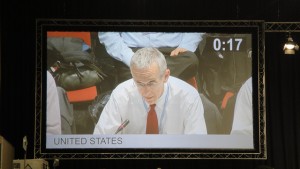 Todd Stern did not even seem to seize the tragic irony of his call for the UN Climate Talks to shift from their current format (which was agreed by not less than 194 countries) and instead adopt an approach inspired by the trade negotiations under the World Trade Organization. The trade negotiations are not just denounced by many as unfair. They have also been stalled with no substantive progress achieved over the past years since the beginning of what is called… the “Doha Round”. Speak about a great source of inspiration for the UNFCCC COP hosted in Doha this November!
I can’t help to wonder what happened the Todd Stern of the year 2009. Back then, Todd Stern made sensation when addressing the UNFCCC for the first time on behalf of the Obama administration. His “we are back” message resonated in a hall filled with delegates frustrated since almost a decade by the Bush administration. The room welcomed this “Return of the Jedi” statement as a promise of a more constructive role for the US. Little did we knew that the Special Envoy would soon choose a darker path…
If you enjoyed this article, please consider sharing it!


-
Senel
-
BORNFACE MLANGIRA
About the author

Passionate environmental advocate, PhD student (Human Rights and Environmental Governance). Following particularly UNFCCC, UNEP and Rio+20 processes
